
Looking to improve your skills in research or clinical practice? Take 5 minutes to learn how respiratory experts approach their work.

Respirology Reflections is our new, expert-led, practice pearls series delivering concise, actionable insights from leading experts in respiratory and pulmonary medicine. Designed to help healthcare professionals stay current, it highlights real-world challenges, emerging evidence, and actionable strategies to enhance clinical practice, strengthen decision-making, and build confidence in an increasingly complex and fast-evolving field.
New insights are added regularly, covering a broad range of subspecialties and evolving clinical scenarios. Sign up below for Free Access to the latest clinical updates in your specialty!
Airway disease
Asthma or COPD? Identifying overlapping features and choosing the right therapy

Asthma and COPD are common airway diseases with distinct underlying mechanisms, yet in everyday practice many patients present with features of both. Differentiating between asthma-predominant and COPD-predominant disease is an important clinical challenge, with significant implications for diagnosis, treatment selection, and long-term outcomes. In this Q&A, Prof. Felix Herth discusses how clinicians can approach patients with overlapping features of asthma and COPD, including the role of clinical history, lung function testing, biomarkers, imaging, treatment selection, and the importance of reassessing response to therapy over time.
Allergy & immunology
Recognizing and managing secondary immunodeficiency in allergy clinics

In the first of our Respirology Reflections series, we spoke with Dr Shahzad Mustafa about recognizing and managing secondary immunodeficiency in adults, particularly those treated for allergy or asthma. He outlines the key medications and infection patterns that should raise concern, how to distinguish secondary from primary immunodeficiency, and which initial tests can guide referral. Dr Mustafa also discusses strategies such as vaccination, prophylaxis, and immunoglobulin replacement, emphasizing the importance of early recognition and coordinated, multidisciplinary care to reduce infectious complications and optimize patient outcomes.
Interstitial lung disease
Therapeutic decision-making in fibrotic interstitial lung disease
 Fibrotic interstitial lung diseases (ILDs) remain difficult to treat due to their clinical heterogeneity, variable trajectories, and an increasingly complex therapeutic landscape. As part of our Respirology Reflections series, we spoke with Prof. Girish B. Nair to discuss early treatment initiation, selecting and sequencing antifibrotic or immunosuppressive therapies, evaluating response and duration, managing side effects, and addressing comorbidities and disease variability over time.
Designing ILD trials to reflect real-world clinical practice
 Interstitial lung disease (ILD) encompasses a heterogeneous group of disorders that pose significant challenges for clinical trial design, from patient selection to endpoint definition and global implementation. Despite advances in therapeutic development, translating trial findings into real-world benefit remains difficult, particularly when study populations and protocols do not fully reflect the complexity of routine clinical practice. As part of our Respirology Reflections series, Dr Tejaswini Kulkarni discusses practical strategies for designing more inclusive and pragmatic ILD trials, including patient selection, recruitment, endpoint choice, and aligning study protocols with real-world care.
Ventilation
Decoding ventilator waveforms: Identifying and addressing asynchrony in critical care

Patient–ventilator synchrony is crucial for effective mechanical ventilation, yet asynchrony is common and often under-recognized, with early signs requiring careful waveform interpretation. In this Q&A, John Davies outlines practical approaches to identifying and managing asynchrony, highlighting missed patterns such as false triggering and cycle asynchrony, and offering strategies to troubleshoot triggering, inspiratory flow, and cycling issues, alongside considerations for sedation and ongoing patient assessment.
Assessing readiness for extubation: Practical guidance on liberation from mechanical ventilation

Liberation from mechanical ventilation is a critical step in intensive care, requiring careful clinical judgement to balance the risks of premature extubation with prolonged ventilatory support. In this Respirology Reflections Q&A, Dr Daniel Ouellette explores practical considerations for assessing readiness for extubation, including the role of spontaneous breathing trials, sedation management and identifying reversible causes of failure. Strategies to reduce the risk of reintubation, including post-extubation respiratory support, are also discussed to help guide decision-making in everyday ICU practice.
touchREVIEWS in Respiratory & Pulmonary Diseases call for submissions!
👉 What We Offer: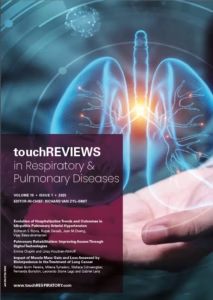
- Peer-reviewed, free-to-access publications;
- Option for enhanced digital features and plain language summaries;
- Multiple article types: original research, reviews, editorials, commentaries and practice pearls; and
- We are supported by an esteemed editorial board.
For more details and to submit your research, visit our journal page.