Looking beyond the program: what respiratory specialists value most when choosing conferences.

With multiple national and international meetings taking place throughout the year, deciding which conferences to attend isn’t always straightforward. While scientific programs are an important consideration, opportunities for networking, collaboration, career development and practical learning can be just as valuable.
To help identify the meetings making the biggest impact across respiratory and pulmonary medicine and related specialties, we asked members of the touchRESPIRATORY community their non-negotiable conferences and what makes them worth attending.
New insights are added regularly, covering a broad range of subspecialties and evolving clinical scenarios. Sign up below for Free Access to the latest clinical updates in your specialty!
The major meetings on our community’s radar
Several flagship conferences emerged from our survey, each recognized for offering something slightly different.
Professor Jean Elwing (University of Cincinnati, Cincinnati, OH, USA) highlighted the American Thoracic Society (ATS) International Conference for its focus on “latest research, late-breaking trials, and large-scale academic networking,” making it a meeting that appeals to researchers and clinicians looking to stay at the forefront of respiratory medicine.
The CHEST Annual Meeting was recommended by multiple respondents, with contributors valuing both its “hands-on procedural training” and “practical clinical updates,” while Dr Sujith V Cherian (University of Texas Health-McGovern Medical School, Houston, TX, USA) highlighted its focus on “new research, collaborations and networking.” For clinicians looking to combine education with practical learning, CHEST clearly stood out as a recurring recommendation.
Respondents also highlighted meetings that offer more specialized expertise. The Pulmonary Hypertension Association (PHA) Scientific Sessions were recognized for “focused pulmonary hypertension education” with “both clinician and patient engagement,” while the International Society for Heart and Lung Transplantation (ISHLT) Annual Meeting was recommended for its emphasis on “advanced lung disease and transplant-focused content.” In addition, the American Association for Bronchology and Interventional Pulmonology (AABIP) was also identified as an important meeting for those working in interventional pulmonology.
Meanwhile, Dr Joseph Lanario (University of Plymouth, Plymouth, UK) described the European Respiratory Society (ERS) Congress as offering researchers “every possible opportunity” to become involved, particularly praising the “multiple poster presentation slots each day” and opportunities for Early Career Researchers to take on roles such as “abstract reviewer” or “Early Career Researchers representative.”
Beyond respiratory-focused meetings, Dr Emmanuel Ukenenye (Brookdale University Hospital and Medical Center, Brooklyn, NY, USA) also identified the American College of Cardiology (ACC), American Heart Association (AHA) and the American College of Physicians (ACP) as valuable conferences, reflecting the close links between respiratory and cardiovascular medicine in clinical practice.
Beyond the science: what makes a conference worthwhile?
 Although respondents recommended different meetings, there was remarkable consistency in what they considered the greatest value of attending.
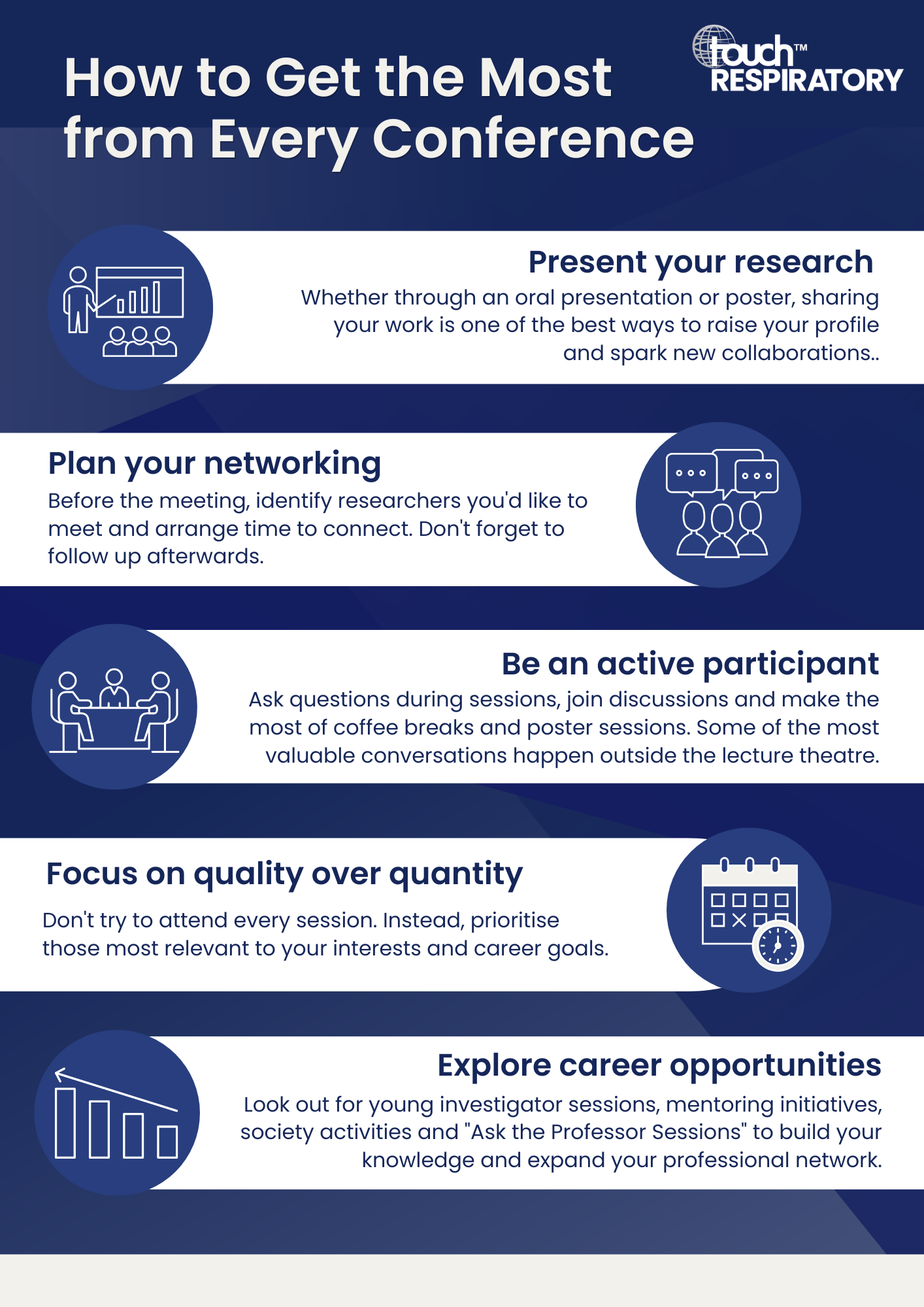
Networking emerged as one of the strongest themes throughout the survey. Rather than simply attending presentations, respondents encouraged delegates to actively seek opportunities to meet colleagues, mentors and collaborators.
One contributor recommended attending “networking sessions and mentorship workshops” and becoming involved in “society activities or committees,” while another advised delegates to “interact with leaders in the field.” Others suggested making the most of question-and-answer sessions before introducing yourself to speakers afterwards, helping conversations continue beyond the lecture hall.
One respondent also encouraged researchers to meet with “Medical Science Liaison (MSL) reps” from pharmaceutical companies, noting that it is “good to understand an industry perspective on research,” while also having the opportunity to “share your own priorities with the MSL.”
For those attending larger meetings, such as ERS, joining Assembly Groups was highlighted as an effective way to build professional relationships, while reviewing the program in advance and arranging meetings with colleagues before arriving at the conference can help turn informal conversations into future collaborations.
Making the most of early-career opportunities
For early-career clinicians and researchers, respondents agreed that conferences offer much more than educational sessions.
Presenting research was consistently identified as one of the most valuable ways to raise your profile. As one respondent advised, “Submit an abstract. Even if it is preliminary work.”
Mentorship also featured prominently throughout the responses. Contributors recommended taking advantage of “mentorship workshops,” seeking out experienced colleagues and following up after the conference. One respondent’s advice was to: “Try to go meet with people in your area of interest! And then follow up and ask if they could be a mentor.”
Respondents also encouraged delegates to volunteer wherever possible. Becoming involved in committees, specialty sections or society initiatives not only increases visibility but also provides opportunities to build lasting professional relationships outside formal conference sessions.
Practical advice for first-time attendees
For anyone attending a conference for the first time, preparation was seen as key.
Respondents recommended reviewing the programme early, planning your schedule in advance and prioritizing sessions that align with your interests and career goals, rather than trying to attend everything.
They also encouraged first-time attendees to be proactive. Asking questions after presentations, introducing yourself to speakers and taking advantage of networking events can make the experience far more rewarding than simply listening to talks.
Finally, respondents highlighted the importance of broadening your perspective. One recommendation was to engage with patient organizations, for example the European Lung Foundation’s Patient Advisory Groups, to better understand how patient perspectives can strengthen research from study design through to dissemination.
Choosing the right conference for you
The survey showed that there is no single “must-attend” meeting for everyone. Instead, the best conference depends on your interests and career stage. Flagship congresses such as ATS, CHEST and ERS continue to provide broad scientific programs and extensive networking opportunities, while more specialized meetings, including PHA and ISHLT, offer focused education within specific disease areas.
Whichever conference you choose, our respondents agreed on one point: the greatest value comes from actively participating. Present your work, ask questions, join a committee, seek out mentors and start conversations. Engaging with the wider community can leave you with new knowledge, new collaborations and lasting professional connections.
This content has been developed independently by Touch Medical Media for touchRESPIRATORY. This article was created by the touchRESPIRATORY team utilizing AI as an editorial tool (ChatGPT (GPT-4o) [Large language model]. https://chat.openai.com/chat.) No funding was received in the publication of this article.
Cite: Planning your conference calendar? Insights from the touchRESPIRATORY community. touchRESPIRATORY. July 02 2026.
Editor: Victoria Smith, Senior Content Editor.